
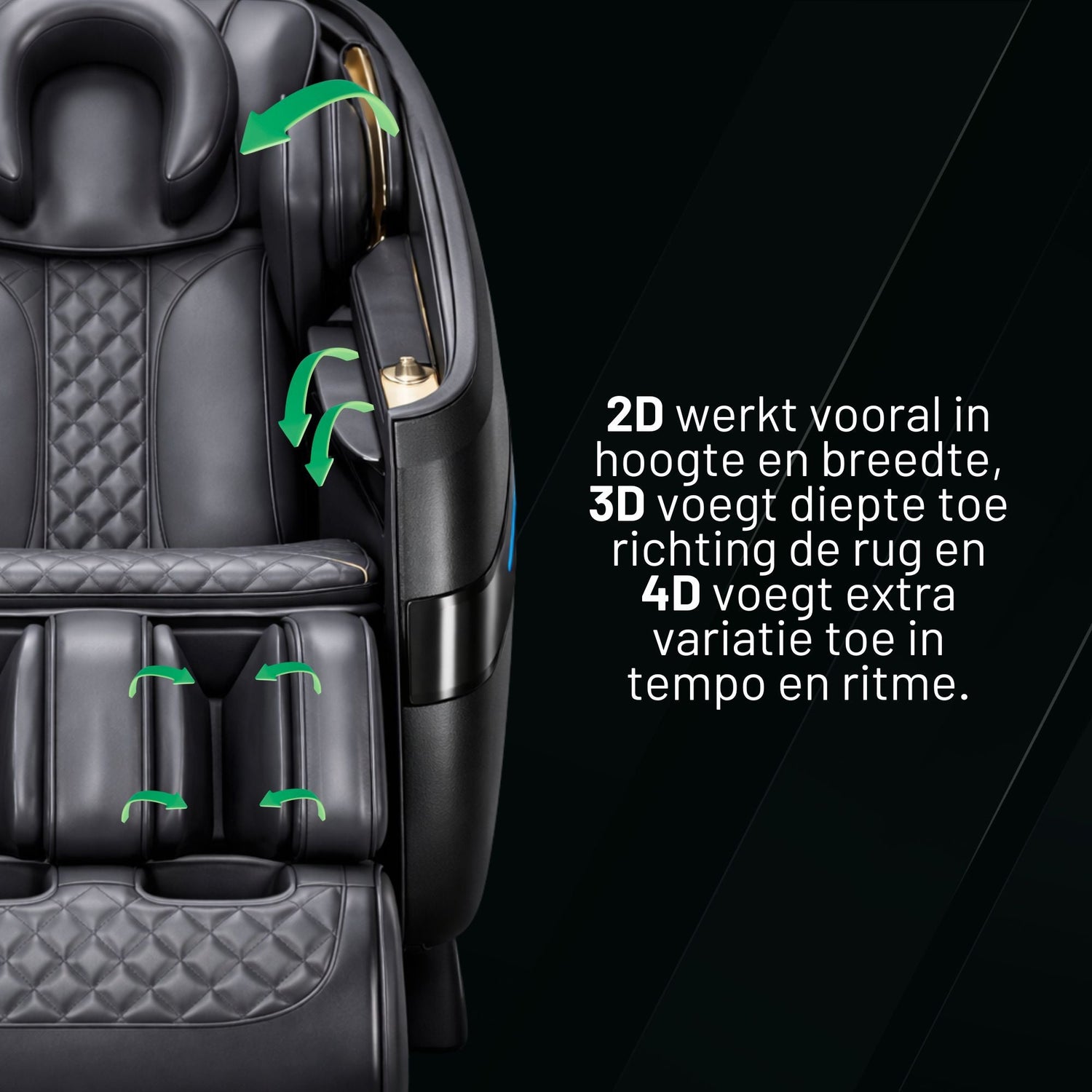
2D, 3D, and 4D massage in a massage chair refers to how massage rollers move and how much depth and dynamics they can deliver. 2D works mainly in height and width. 3D adds depth toward your back. 4D adds extra variation in tempo and rhythm, making the massage feel more adaptive.
In this guide, you get a clear, practical explanation. You learn what the terms do and do not mean, what to watch for when comparing, and how to choose the right technology based on your goal and body type.
Why 2D, 3D, and 4D massage is important when choosing a massage chair
The technology behind the rollers largely determines the experience. It affects pressure buildup, coverage, comfort, and how much you perceive a massage as “just right.” Many shoppers compare based on 2D, 3D, or 4D, but the reality is that brands do not always define these terms identically. Therefore, it is crucial not to rely solely on the label but on what the technology actually does in practice.
Important to remember
2D, 3D, and 4D are guidelines, not universal standards. Look at the combination of technique, programs, intensity control, body scan, and ergonomic features like Zero Gravity.
What is 2D massage in a massage chair
In 2D massage, the rollers mainly move up and down and left and right. This delivers a consistent, often mild to medium massage. In many cases, 2D is the most predictable technique and therefore suitable for users who prioritize comfort and simplicity.
What you notice in practice
Constant pressure and rhythm
Good basis for relaxation and daily use
Less emphasis on deeper “pressure in the back”
Often attractive in price and low in entry complexity
When 2D usually fits well
If you mainly seek relaxation
If you are sensitive to intensity
If multiple family members use the chair and you want a safe baseline
See here massage chairs with 2D massage
What is 3D massage in a massage chair
3D massage adds a third dimension: the rollers can move deeper toward the back and back again. This makes a massage more targeted, especially around the shoulder blades, lower back, and paraspinal muscles. 3D is often the step where people first feel a clear difference compared to “just rolling over the back.”
What you notice in practice
More depth control and pressure variation
Better suited for targeted zones
More need for good individual adjustment
The experience is more strongly influenced by body scan and posture
When 3D usually fits well
If you are looking for targeted back comfort
If you want to be able to increase intensity
If you want to tailor different programs to tension per zone
What is 4D massage in a massage chair
4D massage builds on 3D but adds extra variation in dynamics. In practice, this means more variation in speed, rhythm, pauses, and sometimes depth profiles per movement. The goal is a massage that feels less mechanical and more “manual” or adaptive.
What you notice in practice
More variation in tempo and rhythm, often a more premium experience
Better control over relaxation versus intensity without simply pressing harder
More dependent on the quality of programs and the roller track
Important nuance
4D does not automatically mean "better for everyone." The added value lies in customization. If programs or settings don’t fit your body, 4D can actually feel too intense or too busy.
Differences between 2D, 3D, and 4D in one overview
2D
Movement: height and width
Experience: consistent, predictable
Use: relaxation, low threshold
Suitable for: comfort seekers, beginners, multiple users
3D
Movement: height, width, and depth
Experience: more targeted, more pressure control
Use: back focus, zones, intensity build-up
Suitable for: users needing deeper massage, good scan important
4D
Movement: 3D plus dynamics in tempo and rhythmExperience: adaptive, premium, less repetitive
Use: fine-tuning per goal, relaxation or intensity per session
Suitable for: users who want maximum customization and use programs
Choice guide: which technique fits your goal
Goal: daily relaxation and routine
Usually suitable: 2D or gentle 3D
Why: predictable, consistent, easy to integrate
Goal: back comfort and zones
Usually suitable: 3D
Why: depth control offers more options to target shoulders and lower back
Goal: premium experience and maximum customization
Usually suitable: 4D
Why: variation in rhythm and tempo makes the session less repetitive and easier to fine-tune
Goal: multiple family members with different preferences
Usually suitable: 3D or 4D with strong intensity control
Why: one chair can deliver different comfort levels through good adjustment
What to watch for when comparing (more important than just 2D, 3D, or 4D)
Body scan and detection
A good scan makes the difference between "almost" and "exactly in the right spot."
Intensity control and zones
Not just how much force is possible, but especially how controlled you can dose it.
Roller track and coverage
How far the track runs, and how smooth the transition feels between back, lower back, and hip area.
Ergonomics and posture
A comfortable posture increases acceptance and consistent use. Also read: https://aliencomfort.nl/blogs/massagestoel-techniek-en-functies/zero-gravity-massagestoel-uitleg
Use scenarios and programs
A chair with strong programs and logical flows is more valuable in practice than isolated specifications.
Practical application: how to get more benefit from 2D, 3D, or 4D
Session duration
10 to 20 minutes per session is an efficient routine for many users.
Build-up
Start at low intensity, increase only after several sessions. This reduces the chance of overly aggressive pressure and increases adoption.
Zone focus
Work purposefully. For example, choose shoulders and lower back instead of always full body at maximum strength.
Consistency
Structure beats incident. Regular use at a medium level often provides more experience than occasional “full throttle”.
AlienComfort™ application: how these technologies work in practice
Within AlienComfort™ the focus is on controlled experience: technology, ergonomics, and programs must together deliver a consistent session. The right technology choice depends on your goal. If you primarily want to compare purchase criteria, start here: https://aliencomfort.nl/pages/massagestoel-kopen
4D technology deep dive: https://aliencomfort.nl/blogs/kennisbank/4d-massagestoel-uitleg
Best choice for back focus: https://aliencomfort.nl/blogs/kennisbank/beste-massagestoel-bij-rugklachten
Zero Gravity and posture: https://aliencomfort.nl/blogs/massagestoel-techniek-en-functies/zero-gravity-massagestoel-uitleg
Business use: https://aliencomfort.nl/pages/massagestoel-zakelijk
Test sitting and fit check: https://aliencomfort.nl/pages/showroom-massagestoelen
If you want to experience in one session what 2D, 3D, or 4D can do for you, schedule a test sit through the showroom: https://aliencomfort.nl/pages/showroom-massagestoelen
What does research say about massage and comfort
Massage is often discussed in research in the context of pain perception, relaxation, and well-being. Outcomes vary by target group and situation, and the quality of studies varies. Generally, massage is viewed as a supportive intervention, not a replacement for medical assessment or treatment. The sources below are useful for substantiation and nuance.
External sources
NCCIH: Massage Therapy overview
https://www.nccih.nih.gov/health/massage-therapy-what-you-need-to-know
Cochrane review: massage for low back pain
https://www.cochranelibrary.com/cdsr/doi/10.1002/14651858.CD001929.pub3/abstractHarvard Health: therapeutic massage for pain relief
https://www.health.harvard.edu/therapeutic-massage-for-pain-relief
PubMed search page massage therapy (for extra studies)
https://pubmed.ncbi.nlm.nih.gov/?term=massage+therapy
Frequently asked questions about 2D, 3D, and 4D massage
Is 4D always better than 3D
Not necessarily. 4D offers more variation in rhythm and speed, but the added value depends on programs, adjustment, and personal tolerance. For many users, a well-adjusted 3D is already optimal.
Is 3D suitable if I mainly want relaxation
Yes, provided you keep the intensity low to medium and choose gentle programs. 3D mainly offers extra control over depth, which you don’t have to use to the maximum.
What do I notice as an upgrade from 2D to 3D
You usually notice more pressure control towards the back, especially around the shoulders and lower back. It feels more targeted but sometimes requires more fine-tuning.
What exactly does 4D stand for
4D is in practice 3D massage plus extra dynamics in speed and rhythm. The goal is a less repetitive, more adaptive experience.
How do I quickly choose the right technology
Focus on the goal. Relaxation and simplicity: 2D or gentle 3D. Back focus and zones: 3D. Premium tuning and variety: 4D. And preferably validate through a test sit.
Conclusion
2D, 3D, and 4D refer to freedom of movement and dynamics of massage rollers, but the practical value lies in adjustment, programs, scanning, and ergonomics. The best choice is the technology you consistently enjoy using. Start from your goal, compare the overall experience, and validate where possible in the showroom.